Best Low Phosphorus Cat Food for Senior Cats with CKD
Your senior cat was just diagnosed with chronic kidney disease, and now you have a long list of dietary restrictions. Welcome to a club no one wanted to join.
The good news is that managing CKD with diet is one of your best tools. Finding low phosphorus cat food doesn’t have to feel like a puzzle.
I\’ve spent a lot of time in this world, talking to vets, reading labels, and watching my senior cat refuse expensive food.
Let me guide you through what you need to know, from the importance of phosphorus to which foods really work.
Why Phosphorus Is the Enemy in CKD
Here is the thing about phosphorus: healthy kidneys handle it just fine. They filter it out and move on.
But when kidney function declines, phosphorus builds up in the bloodstream, and that buildup accelerates kidney damage. It becomes a vicious cycle.
Restricting dietary phosphorus slows that cycle down significantly. Studies consistently show that cats on low phosphorus diets survive longer and maintain better quality of life after a CKD diagnosis.
This is not just a nice-to-have, it is genuinely one of the most important dietary adjustments you can make for your cat.
The target most veterinary nutritionists recommend is phosphorus content below 0.5% on a dry matter basis for cats with CKD.
Some cases require even lower levels depending on the stage of disease. Always check with your vet for the specific target that fits your cat\’s bloodwork.
Understanding CKD Stages and Dietary Needs
Not all CKD is the same, and your cat\’s stage of disease should guide how aggressively you restrict phosphorus.
Stage 1 and Stage 2 CKD
In early stages, kidney function is reduced but the cat may show few obvious symptoms. Phosphorus restriction is still recommended, but the urgency is lower.
A moderate reduction, combined with increased hydration, can meaningfully slow progression.
Stage 3 and Stage 4 CKD
At these advanced stages, phosphorus restriction becomes critical. Your vet may also recommend phosphate binders, which are supplements added to food that prevent phosphorus absorption in the gut.
These can be especially useful when a cat refuses to eat therapeutic kidney diets.
Why Protein Is a Complicated Conversation
Here is where things get a little nuanced. Some older advice recommended drastically cutting protein in CKD cats, but current veterinary thinking is more cautious.
Senior cats need adequate protein to maintain muscle mass. The goal is high-quality, moderate protein rather than rock-bottom protein content.
Low phosphorus and high quality protein can coexist, and the best kidney diets manage exactly that balance.
Wet Food vs. Dry Food for CKD Cats
If there is one thing most vets agree on, it is this: wet food wins for CKD cats. Hands down, no contest.
Cats with CKD have compromised kidneys that struggle to concentrate urine, which means they are at constant risk of dehydration.
Wet food provides significant moisture with every meal, which supports kidney function and helps flush waste products from the body.
A cat eating exclusively dry food is essentially relying on her water bowl alone, and most cats simply do not drink enough on their own.
Dry food is not completely off the table, especially for cats who flat-out refuse wet food. But if your cat tolerates wet food at all, making it the primary diet is one of the most impactful things you can do.
Even mixing a little wet food into dry kibble increases moisture intake meaningfully.
What to Look for on a Cat Food Label
Reading cat food labels for a CKD cat is a skill that takes a little practice. Here is what to focus on:
- Phosphorus percentage (dry matter basis): This is the most important number. Convert the \”as-fed\” percentage on the label to dry matter basis to make accurate comparisons.
- Protein source and quality: Named proteins like chicken, turkey, or salmon are preferable to vague \”meat by-products.\”
- Sodium content: Elevated sodium can worsen hypertension, which is common in CKD cats. Look for moderate, not high, sodium levels.
- Added phosphorus preservatives: Some foods use phosphoric acid or sodium phosphate as additives. These spike phosphorus content and are worth avoiding.
- AAFCO statement: Make sure the food is labeled complete and balanced for adult maintenance or all life stages.
A quick tip: the guaranteed analysis panel on the bag or can shows phosphorus \”as fed,\” which includes moisture.
To compare foods fairly, especially wet versus dry, convert everything to dry matter basis by dividing the nutrient percentage by the dry matter percentage of the food.
Top Types of Low Phosphorus Cat Food to Consider
Rather than running through a generic list of brand names, let me break this down by category, because what works depends heavily on your individual cat\’s preferences and stage of disease.
Prescription Kidney Diets

These are formulated specifically for CKD management and tend to offer the most rigorously controlled phosphorus levels.
Brands like Hill\’s Prescription Diet k/d, Royal Canin Renal Support, and Purina Pro Plan Veterinary Diets NF are the most commonly recommended options.
They require a veterinary prescription for good reason: they are not appropriate for healthy cats and should only be used under vet supervision.
The phosphorus levels in these diets typically fall between 0.3% and 0.5% on a dry matter basis, which is exactly where you want to be for moderate to advanced CKD.
The trade-off? Some cats hate the taste. And cats, as you may have noticed, have opinions about everything.
Over-the-Counter Low Phosphorus Options

For cats with early-stage CKD or cats who categorically refuse prescription food (we all know that cat), there are over-the-counter options worth exploring.
Some foods marketed for seniors naturally contain lower phosphorus simply because they use less meat meal and more whole protein sources.
Look for options where phosphorus falls between 0.5% and 0.8% dry matter.
While this is not as aggressive as prescription diets, it offers meaningful restriction compared to standard adult foods, which can clock in above 1%.
Raw and Home-Cooked Diets

Home-cooked diets for CKD cats have a devoted following, and there is genuine merit to the concept.
A properly formulated home-cooked diet can hit precise phosphorus targets while using high-quality ingredients your cat actually enjoys. The catch is the word \”properly formulated.\”
A homemade diet without veterinary nutritionist input can create dangerous deficiencies or imbalances.
If you want to go this route, consult a board-certified veterinary nutritionist rather than relying on online recipes.
Getting a Picky CKD Cat to Actually Eat
Here is the part nobody warns you about: CKD cats are often nauseous and have reduced appetite, which makes diet transitions genuinely hard.
You introduce the kidney diet, your cat looks at it, looks at you, and walks away. Spectacular.
A few strategies that actually help:
- Transition gradually: Mix the new food with the old food over two to three weeks, slowly increasing the proportion of the new diet.
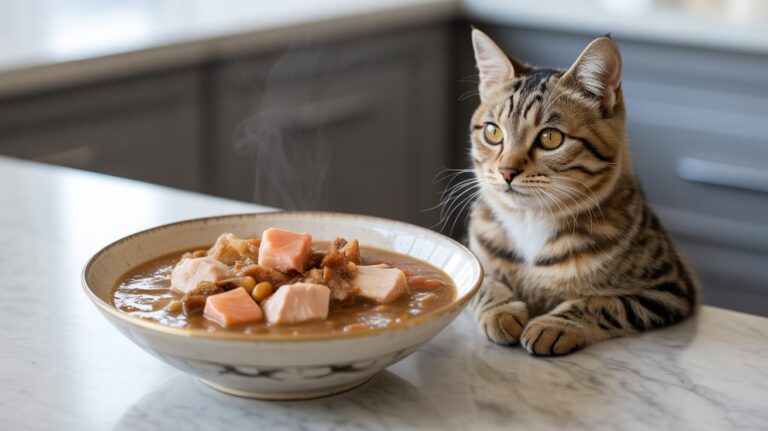
- Warm the food slightly: Warming wet food to just below body temperature releases aroma and makes it more appealing to cats with reduced appetite.
- Try different textures: Some CKD cats prefer pate over chunks in gravy, or vice versa. Experiment until you find the winner.
- Feed smaller, more frequent meals: Large meals can trigger nausea in CKD cats. Smaller portions spread throughout the day tend to go down better.
- Ask about appetite stimulants: If your cat is consistently refusing food, your vet may recommend mirtazapine or capromorelin, both of which can meaningfully improve appetite in CKD cats.
Explore Wet Cat Food Varieties for Picky Senior Cats on Amazon
The Role of Hydration Beyond Food
Food choice matters enormously, but hydration deserves its own spotlight.
Encouraging a CKD cat to drink more water reduces the workload on damaged kidneys and helps prevent the dehydration that accelerates disease progression.
A few practical ways to boost water intake include offering a cat water fountain, since many cats prefer moving water over still water in a bowl.
You can also add a small amount of low-sodium broth to water or food to make it more enticing. Some cats will accept subcutaneous fluids administered at home, which your vet can teach you to give.
It sounds more dramatic than it is, and many cats actually tolerate it well.
Regular Monitoring Is Non-Negotiable
Even with the best diet in place, CKD management requires regular bloodwork. Phosphorus levels, BUN, creatinine, and SDMA values tell you whether the diet is working and whether adjustments are needed.
Most vets recommend rechecking bloodwork every three to six months for stable CKD cats.
Do not skip these appointments thinking the diet is doing its job without checking. Kidney disease is progressive, and what works brilliantly at Stage 2 may need adjustment by Stage 3.
Staying on top of the numbers keeps you ahead of the disease rather than chasing it.
Final Thoughts
Managing CKD in a senior cat is genuinely one of the harder parts of cat ownership, but it is also one of the areas where your effort makes a measurable difference.
The right low phosphorus diet, consistent hydration, and regular vet monitoring form the foundation of good CKD management.
That foundation can add months or even years of good quality life to your cat\’s story.
Start with a conversation with your vet about your cat\’s specific phosphorus targets, try a prescription kidney diet first if tolerated, and do not give up if the first option gets rejected.
Cats specialize in rejected options. Keep experimenting, keep monitoring, and give yourself credit for caring enough to get this right.
Your senior cat is lucky to have someone reading ingredient labels on her behalf.
How Much Phosphorus Should a Cat With CKD Consume Daily?
Most veterinary nutritionists suggest keeping phosphorus below 0.5% on a dry matter basis for cats with CKD. For those in Stage 3 or 4, your vet may recommend a target closer to 0.3%.
The exact amount varies based on your cat\’s bloodwork, weight, and daily food intake. Always consult your vet for the specific number. Each CKD cat is unique.
Can a Cat With CKD Eat Regular Senior Cat Food?
Regular senior cat food isn’t the same as food for kidney disease, even if it claims to support urinary or kidney health.
Most standard senior formulas have much higher phosphorus levels than a CKD cat should eat. Some over-the-counter options have lower phosphorus, which can be okay for early-stage CKD.
However, for moderate to advanced disease, a prescription kidney diet is often safer and more effective.
Is Wet Food or Dry Food Better for Senior Cats With Kidney Disease?
Wet food is much better for cats with CKD. It adds hydration with every meal. Cats with kidney disease have trouble concentrating urine and can easily become dehydrated.
This dehydration can worsen kidney damage. Dry food relies on your cat\’s water bowl for hydration, but many cats don’t drink enough.
If your cat can handle wet food, make it the main part of their diet. This change can have a big impact.
What Ingredients Should You Avoid in Cat Food for CKD?
When choosing cat food for CKD, steer clear of these items:
- Phosphoric acid and sodium phosphate as preservatives or additives. They raise phosphorus levels significantly.
- High sodium ingredients like processed broths. These can worsen hypertension in CKD cats.
- Meat meals and bone meal as main protein sources. They have much higher phosphorus levels than whole meat.
- Artificial preservatives like BHA, BHT, and ethoxyquin. These add extra chemicals that stress the kidneys.
Check the ingredient list and guaranteed analysis panel to see what\’s really in the food.
How Do You Transition a Picky Senior Cat to a Kidney Diet?
Transitioning a picky senior cat to a kidney diet takes time and care. Start by adding a small amount of the new food—about 10 to 20 percent—into your cat\’s current food.
Increase this amount every three to four days over two to three weeks. Warming the food a bit can help. Offer smaller, more frequent meals, and try different textures, like pate or chunks, to boost acceptance.
If your cat still refuses to eat, consult your vet about appetite stimulants like mirtazapine. These can help cats with CKD-related nausea and low appetite.