Cat Scratching Posts With Dangling Toys for Indoor Cats
Your couch didn’t agree to this. Neither did your curtains, carpet edges, or that one chair leg your cat has claimed as a foe. If you have an indoor cat, scratching isn’t a problem to fix.
It’s a need to redirect. The best way to do this? A cat scratching post with dangling toys. It keeps your cat engaged and interested.
Here’s what many cat owners overlook: a scratching post without interactive features is just furniture your cat tolerates.
But add a dangling toy, and you provide both physical and mental stimulation. This article covers how to choose, place, and maximize the benefits of these combo posts for your indoor cat.
Why Indoor Cats Need More Than Just a Plain Scratching Post
The Science Behind Scratching Behavior
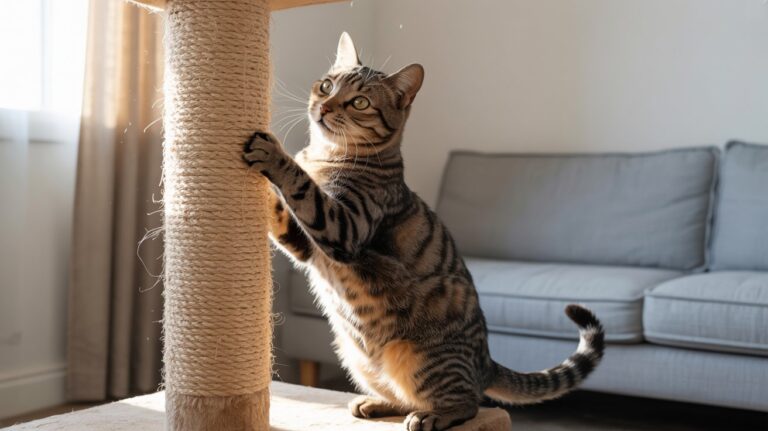
Cats scratch for reasons that go well beyond sharpening their claws. Every time your cat drags their paws down a surface, they are doing several things simultaneously:
- Removing dead outer claw sheaths to expose sharper layers underneath
- Stretching the muscles in their legs, shoulders, and spine
- Depositing scent from glands located in their paw pads to mark territory
- Releasing pent-up energy and reducing stress
Scratching is not destructive behavior. It is healthy, normal, and necessary.
The only problem is when your cat decides your furniture qualifies as an appropriate scratching surface, which, if you have ever come home to a shredded sofa, you know feels deeply personal.
Why Indoor Cats Have Higher Stimulation Needs
Outdoor cats spend their days hunting, climbing, chasing, and patrolling territory. They get a full sensory workout just by existing outside.
Indoor cats, on the other hand, live in a comparatively predictable environment where nothing unexpected happens unless you drop something in the kitchen.
Boredom is one of the leading causes of destructive scratching in indoor cats. When a cat has no outlet for their predatory instincts, they find their own entertainment.
That entertainment usually involves something you own.
A scratching post with dangling toys addresses both the scratching need and the mental stimulation gap in one product, which makes it one of the most practical investments you can make for an indoor cat’s wellbeing.
What to Look for in a Cat Scratching Post With Dangling Toys
Height and Stability Are Non-Negotiable
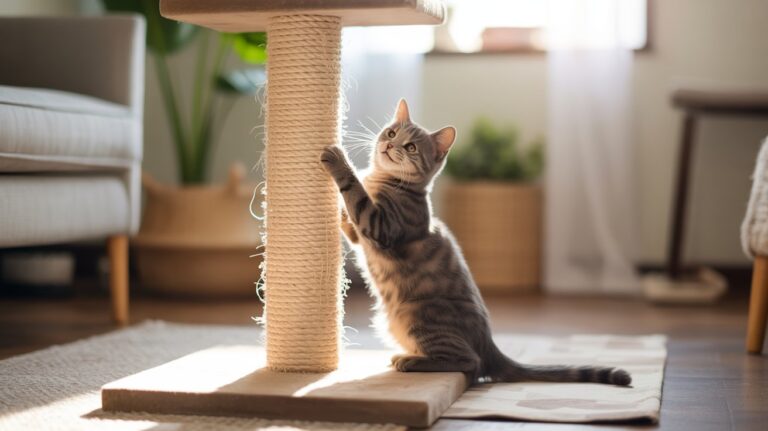
This is the detail that separates a scratching post your cat actually uses from one that collects dust in a corner. Cats scratch most effectively when they can fully extend their bodies.
For most adult cats, that means a post that stands at least 28 to 32 inches tall.
Anything shorter and your cat physically cannot get a proper stretch, which means they will look elsewhere for a surface that lets them reach properly.
Stability matters just as much as height. A post that wobbles or tips when your cat leans into it will earn exactly one attempt before your cat writes it off forever.
Look for a heavy, wide base or a base that you can weigh down with something. If the post rocks when you press on it firmly with your hand, your cat will reject it faster than they reject a closed bathroom door.
The Scratching Surface Material
Different cats genuinely prefer different textures, and figuring out your cat’s preference saves you from buying three posts before finding the right one. The main options are:
- Sisal rope: The gold standard for most cats. Sisal has a satisfying resistance and texture that mimics bark, making it the closest thing to what cats scratch in nature. It also holds up exceptionally well over time.
- Sisal fabric: Similar to rope but with a slightly smoother surface. Some cats prefer this, especially cats that like to scratch horizontally as well as vertically.
- Cardboard: Great for cats that prefer horizontal or angled scratching. Less durable than sisal but inexpensive and very easy to replace.
- Carpet: Popular in older post designs but honestly not the best choice. Carpet can teach cats that carpet-like textures are acceptable scratching surfaces, which creates obvious problems elsewhere in your home.
Sisal rope or sisal fabric wraps the post tightly and wears slowly, giving you far better value over time compared to carpet-covered posts.
Shop Sisal Cat Scratching Posts On Amazon
Evaluating the Dangling Toy Component
Here is where many scratching posts fall short. The dangling toy is often an afterthought, a cheap feather glued to a spring, that loses its appeal within a week.
When you evaluate the toy attachment, ask yourself a few honest questions.
Does it move in an unpredictable way that mimics prey? Does it hang at a height that actually interests your cat? Can you replace the toy when it wears out?
The best dangling toy setups use:
- Spring-mounted attachments that create erratic, bouncy movement
- Interchangeable toy heads so you can swap in new textures or shapes
- Feather, crinkle, or bell elements that engage multiple senses simultaneously
- Adjustable height positioning so kittens and adult cats both find the toy accessible
A toy that hangs dead and motionless does nothing. The movement is the whole point.
Types of Cat Scratching Posts With Dangling Toys
Single-Post Designs
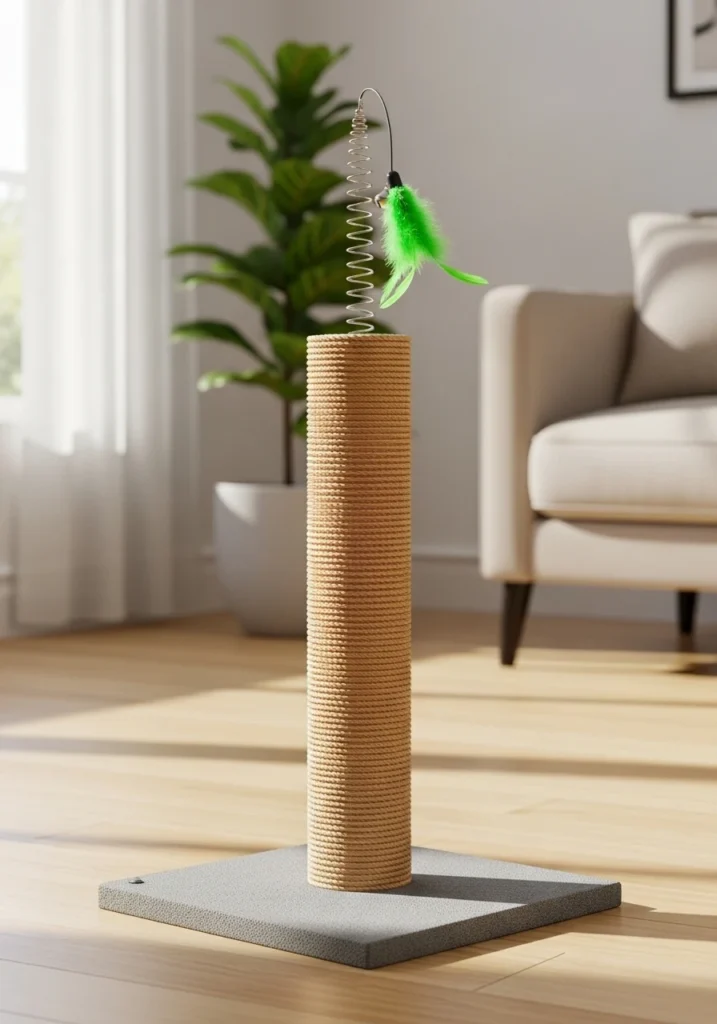
The simplest version is a single upright post with a toy attached at the top or along the side.
These work well for smaller spaces and cats that just need a designated scratching spot with a little extra entertainment. They tend to be the most affordable option and take up minimal floor space.
Single posts suit apartments, small homes, or owners who want one well-placed scratching solution in a specific room.
The limitation is that they offer no climbing or perching benefit, so cats that crave vertical territory will likely want more.
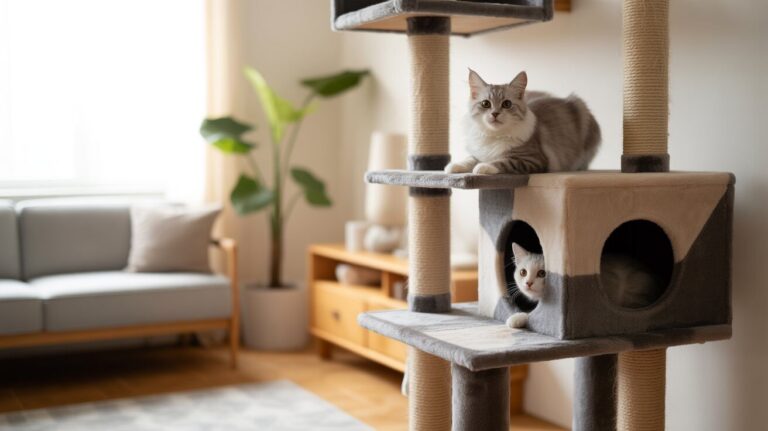
Multi-Level Cat Trees With Integrated Scratching and Toys
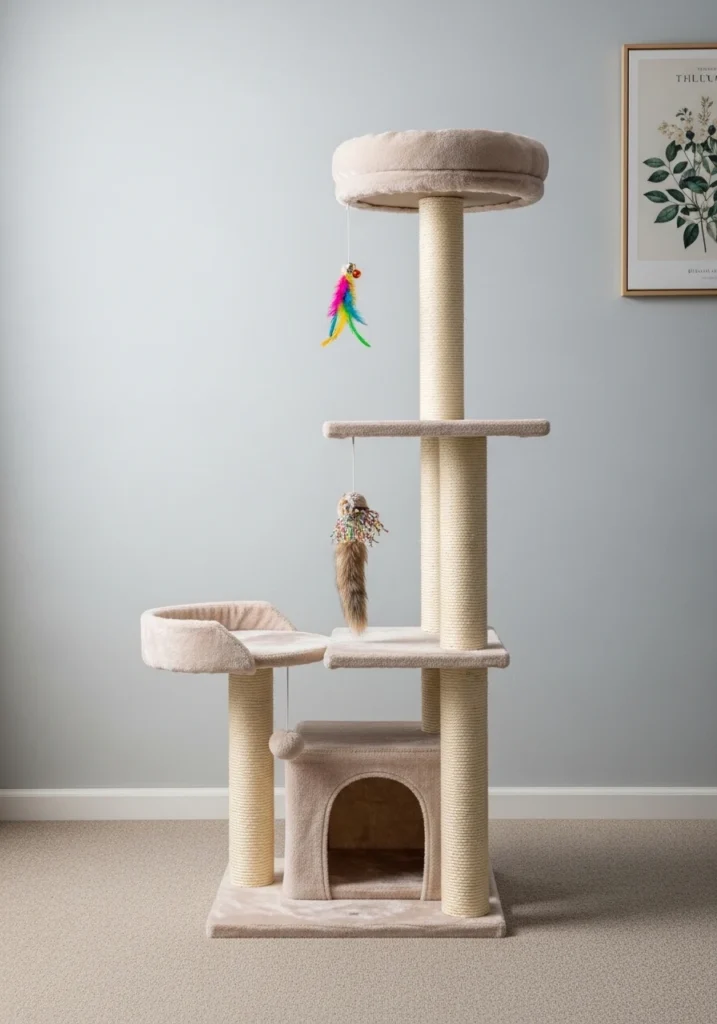
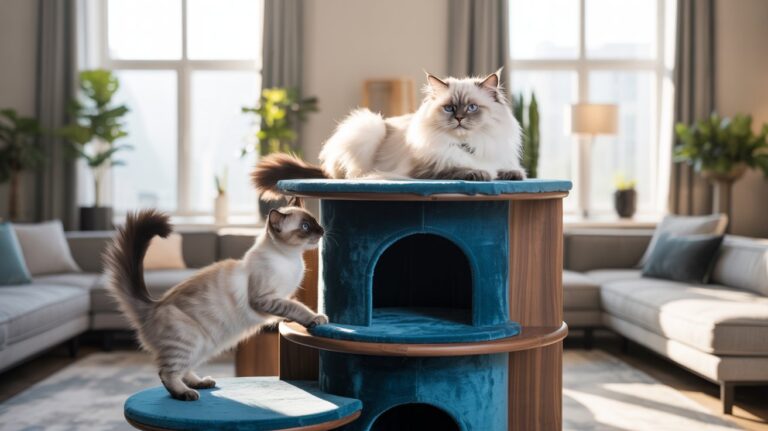
Cat trees represent the premium end of this category.
A good cat tree combines scratching posts at multiple levels, elevated perches for territory surveying, enclosed cubbies for hiding, and dangling toys positioned throughout.
For indoor cats, a cat tree essentially recreates the vertical landscape they would naturally explore outdoors.
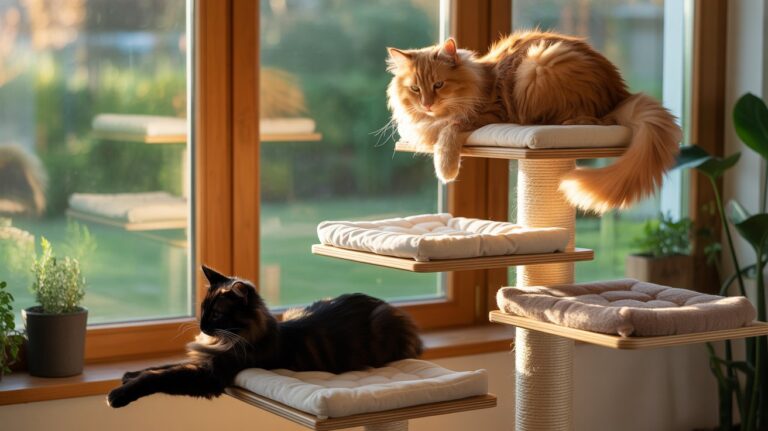
Multi-level designs work particularly well in homes with multiple cats because they provide enough space for each cat to claim their own territory at different heights.
If you have ever watched two cats navigate a single-level environment, you know that vertical space is social currency in a multi-cat household.
Browse Cat Trees With Scratching Posts And Toys On Amazon
Floor-to-Ceiling Tension Posts
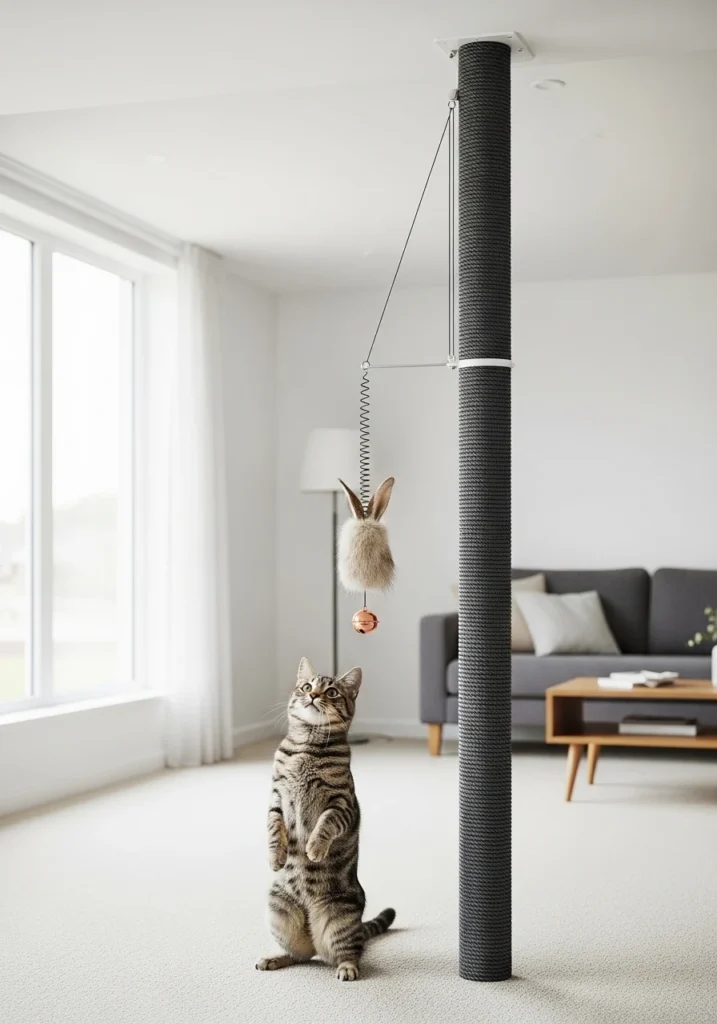
These posts use tension between the floor and ceiling to stay upright without requiring a heavy base. They look sleek, feel incredibly stable, and allow for serious scratching force without any wobbling.
Many come with dangling toys attached at various heights. The main consideration is ceiling height compatibility, so always check the product’s adjustable range before ordering.
Find Floor-To-Ceiling Cat Scratching Posts On Amazon
Where to Place the Scratching Post for Maximum Use
Location Drives Adoption
You can buy the most well-designed scratching post on the market and still have your cat ignore it if you put it in the wrong spot. Cats scratch in locations that carry social significance.
That means high-traffic areas, spots near sleeping locations, and places near entry points to rooms.
Never hide the scratching post in a back room or corner where your cat rarely goes. The post needs to be where the cat already spends time.
Near their favorite sleeping spot is ideal because cats frequently scratch immediately after waking up as part of their stretching routine.
Redirecting Cats Away From Furniture
If your cat has an existing preference for a specific piece of furniture, place the new scratching post directly next to that furniture rather than across the room.
You want to intercept the behavior at the source, not ask your cat to abandon a habit and walk to a new location.
Once your cat regularly uses the post, you can gradually shift it a few inches at a time toward a more convenient location.
You can also make the furniture temporarily less appealing by covering the scratched area with double-sided tape or a plastic furniture protector sheet.
Cats strongly dislike sticky textures on their paws, and a few days of encountering that sensation near their old scratching spot is usually enough to break the association.
Keeping Your Cat Interested Over Time
Rotating the Dangling Toy Keeps Things Fresh
Cats are novelty seekers. That dangling feather toy that your cat attacked with full predatory commitment on day one will lose its appeal within a few weeks simply because it stops feeling new.
The solution is rotation. Swap in a different toy attachment every week or two, or temporarily remove the toy and reintroduce it after a break.
The reappearance of a “missing” toy reliably triggers renewed interest in most cats.
Catnip and Silver Vine Encourage Initial Engagement
If your cat shows little interest in the new post, a small amount of dried catnip or silver vine rubbed into the sisal surface works remarkably well at drawing attention to it.
Silver vine actually produces a stronger response in cats than catnip and works on cats that do not respond to catnip at all. You do not need much.
A light application is enough to trigger curiosity, and once your cat starts pawing at the post, the scratching instinct takes over naturally.
Shop Catnip And Silver Vine For Cats On Amazon
Praise and Play Reinforce the Right Behavior
Cats respond to positive reinforcement even if they pretend not to. When your cat uses the scratching post, acknowledge it enthusiastically.
Use a play wand to guide your cat toward the post and initiate interactive play sessions near it so the post becomes associated with fun rather than just being a static object in the room.
The more positive associations your cat builds with the post, the more reliably they return to it.
Wrapping It All Up
Indoor cats need scratching. They also need mental stimulation, physical activity, and something worth paying attention to.
A well-chosen cat scratching post with dangling toys delivers all of that in one product, which makes it one of the most practical and honestly underrated items in the indoor cat owner’s toolkit.
Choose a post that is tall enough for a full stretch, stable enough to withstand serious scratching force, and wrapped in sisal for durability.
Make sure the dangling toy moves realistically and comes with options for replacement or rotation.
Place it where your cat already spends time, introduce it with catnip if needed, and reinforce the habit with play and praise.
Do all of that and your sofa might just survive the year. No guarantees about the curtains, though.
Shop Cat Scratching Posts With Dangling Toys On Amazon
Why Do Indoor Cats Need a Scratching Post With a Dangling Toy?
Indoor cats miss the physical and mental stimulation that outdoor cats get from hunting, climbing, and exploring.
A scratching post with a dangling toy meets two key needs: it provides a surface for scratching and stretching, while the toy satisfies their hunting instincts.
Without these outlets, indoor cats may scratch furniture, carpets, and curtains instead. Combining scratching and play in one station makes it a top enrichment tool for fully indoor cats.
What Is the Best Material for a Cat Scratching Post?
Sisal rope and sisal fabric are the best materials for scratching posts for most cats. Sisal has a rough texture that feels like tree bark, which cats love outdoors.
It stands up well to strong scratching and doesn’t shed fibers that cats might swallow. Cardboard is a good second option for cats that like to scratch horizontally, but it wears out quickly.
Carpet-covered posts are the least recommended. They can lead cats to scratch other carpets in your home.
How Do I Get My Cat to Use a New Scratching Post With a Dangling Toy?
Placement is key. Position the new scratching post near your cat’s favorite sleeping spot or next to furniture they already scratch.
Cats don’t usually look for new items in unfamiliar corners. You can rub dried catnip or silver vine into the sisal to spark interest.
Use an interactive wand toy to lead your cat to the post during playtime. Once your cat scratches it a few times, they will likely use it regularly on their own.
How Tall Should a Cat Scratching Post Be for an Adult Cat?
A scratching post for an adult cat should be 28 to 32 inches tall. Cats need to stretch fully when they scratch to gain the full benefit.
A post that is too short makes your cat hunch, which reduces the physical benefit and makes it less enjoyable to use. Stability is also key.
A tall post with a narrow or lightweight base will wobble. Most cats will stop using a post that tips or shifts when they lean into it.
How Often Should I Replace the Dangling Toy on a Scratching Post?
Refresh or rotate the dangling toy every one to two weeks. This keeps your cat interested. Cats love new things, and a toy that doesn’t change can quickly become boring.
Many good scratching posts have interchangeable toy attachments. This makes rotation simple and cost-effective. If your post has a fixed toy, try removing it for a week.
Reintroducing it later can boost your cat’s enthusiasm. Feather, crinkle, and bell attachments usually hold a cat’s attention longer than plain fabric toys. They engage multiple senses at once.