Corner Cage Storage That Actually Maximizes Your Space
You know that awkward feeling when you stare at a corner in your garage, basement, or workshop and think, “There has to be a better way.”
Corners are often the most wasted space in any storage setup. If you’ve been jamming random items into them and calling it organized, you’re not alone.
Corner cage storage can change that completely. Once you see how it works, you’ll wonder why you didn’t set one up sooner.
This guide covers everything you need about corner cage storage: how to choose the right system, how to maximize it, and how to avoid common mistakes that turn a great idea into a cluttered mess.
What Is Corner Cage Storage, and Why Should You Care?
Corner cage storage refers to enclosed shelving or wire mesh cage units specifically designed to fit into corner spaces.
Unlike a standard shelf you just shove into a corner and hope for the best, a proper corner cage unit uses the angular geometry of the space to hold significantly more while keeping everything visible and accessible.
Think of it this way: a standard shelf loses the corner entirely because you cannot reach the back without basically climbing in.
A corner cage system eliminates that dead zone and puts every square inch to work.
The Corner Problem Nobody Talks About
Corners create two problems simultaneously: wasted horizontal depth and awkward access angles.
Most people solve this by either ignoring the corner altogether or by stacking boxes there until it becomes an archaeological dig site. Neither option is great.
Corner cage storage solves both issues because the cage structure itself is built to angle around the corner.
You get full depth utilization on both walls, and because the cage is open or semi-open on the front, you can actually see what you stored in there six months ago.
Types of Corner Cage Storage Systems
Not all corner cage storage looks the same, and choosing the wrong type is how people end up back at square one. Here is a breakdown of the main types and what each one actually does well.
Browse Corner Cage Storage Options On Amazon
Wire Mesh Corner Cages
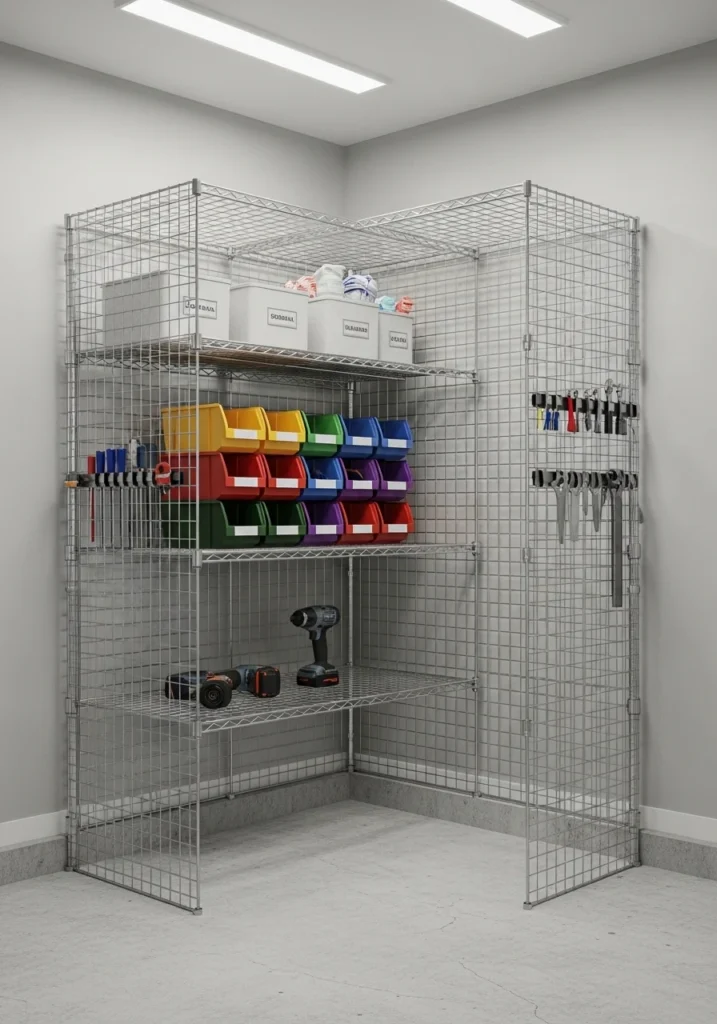
Wire mesh corner cages are probably the most common option you will find, and for good reason.
The open grid design gives you full visibility of everything inside, which is genuinely useful when you are looking for that one specific tool or box you know is “in there somewhere.”
Key benefits of wire mesh corner cages:
- Full visibility through the sides and back
- Strong airflow, which matters for anything moisture-sensitive
- Typically lighter than solid-panel alternatives
- Easier to attach hooks, clips, and accessories directly to the mesh
The trade-off is that wire mesh offers zero protection from dust and does not look particularly polished.
If your garage or basement is already a working space rather than a showroom, that probably does not bother you much.
Shop Wire Mesh Corner Cage Units On Amazon
Solid Panel Corner Cages
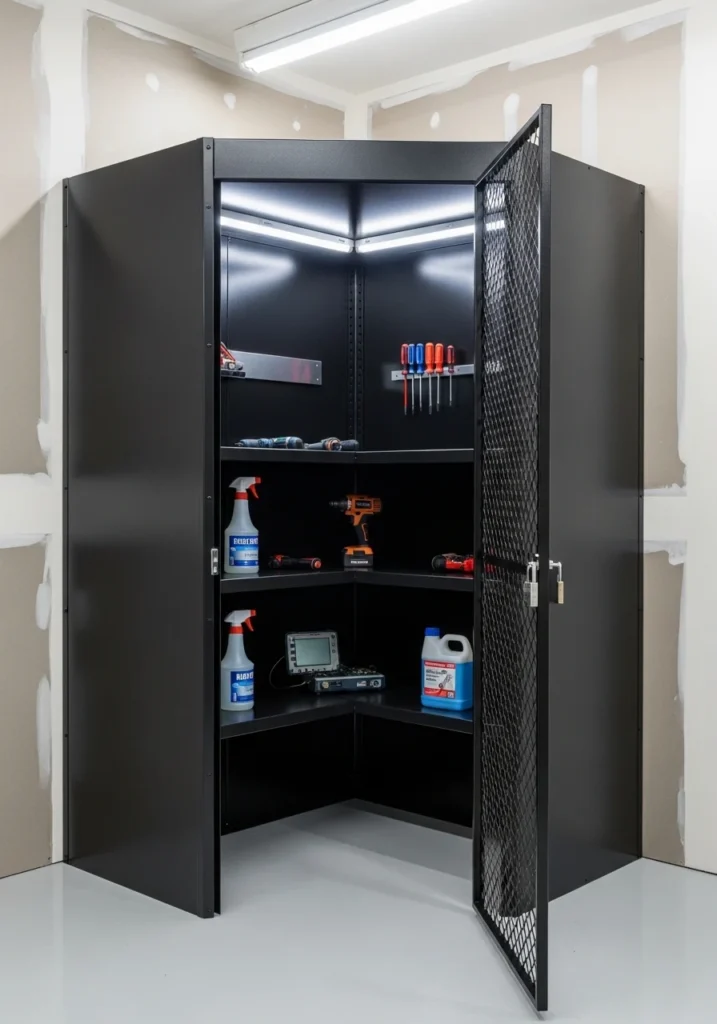
Solid panel corner cages, usually built from steel or heavy-duty polypropylene, give you more protection for what is inside.
They are popular in commercial storage settings but work extremely well in home garages too.
Where solid panel cages shine:
- Protecting tools, electronics, or chemicals from dust and debris
- Higher load ratings per shelf in most cases
- Better security when paired with a lock
- Cleaner visual appearance if your space doubles as a home workshop
The downside here is cost. Solid panel units almost always run pricier than wire mesh equivalents, and they tend to be heavier to install.
Modular Corner Cage Systems
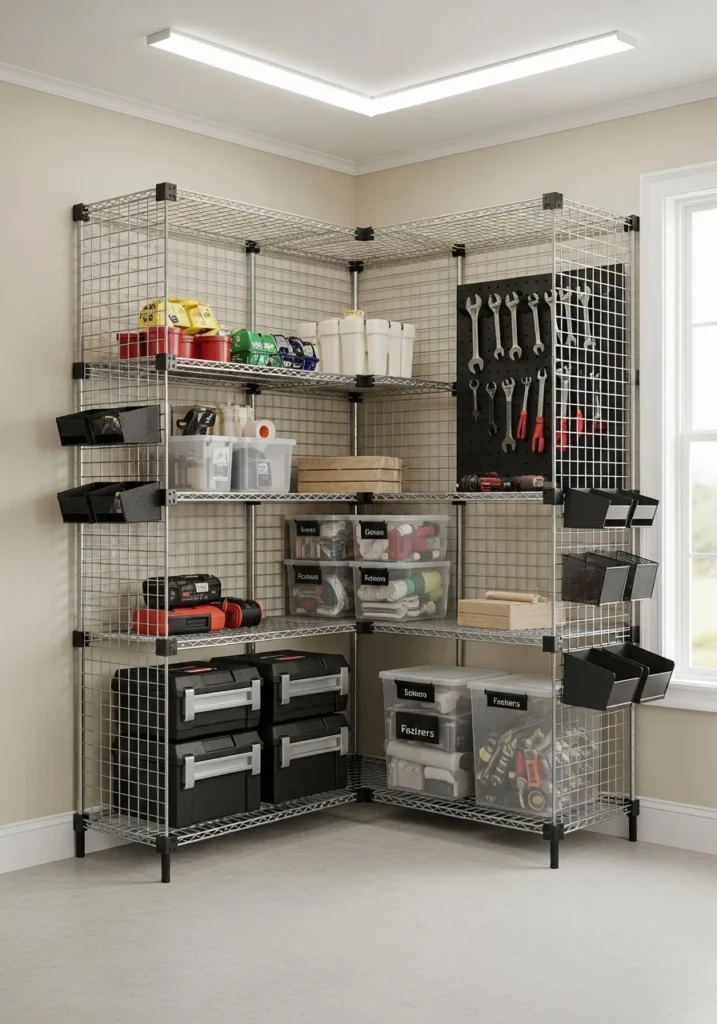
Modular systems are the most flexible option available. You buy individual panels, shelves, and connectors and build the cage specifically for your corner dimensions.
This matters more than most people realize because not every corner is a perfect 90 degrees, and standard units sometimes fit badly enough to create more problems than they solve.
Why modular systems are worth the extra effort:
- Custom fit to your exact corner dimensions
- Expandable as your storage needs grow
- Easier to reconfigure without buying a whole new unit
- Better for irregular or unusually deep corners
How to Actually Maximize Your Corner Cage Storage
Buying the right cage is only half the job. The other half is using it intelligently. Here is where most people drop the ball because they treat corner storage like a general dumping zone rather than a system.
Start With a Zone Plan
Before you shove anything into the cage, decide what category of items belongs there. Corner cages work best when they hold one category or one project’s worth of gear.
The moment you start mixing automotive supplies with gardening tools with holiday decorations, you have just created an expensive corner pile.
Practical zone ideas that actually work:
- Dedicated tool storage for hand tools and power tool accessories
- Seasonal gear that rotates in and out twice a year
- Workshop consumables like fasteners, adhesives, and sandpaper
- Safety equipment like gloves, goggles, and ear protection
Pick one and stick with it. You will thank yourself later.
Use Every Vertical Inch
Most people use the bottom two or three shelves of any storage unit and completely ignore the upper half.
This is storage space left on the table, and with corner cages it is even more wasteful because the vertical height is usually generous.
Strategies for using vertical space properly:
- Store rarely accessed items on the top shelves
- Put the heaviest items on the bottom two shelves for stability
- Use labeled bins on upper shelves so you know what is there without climbing up
- Install a small step stool nearby so upper shelf access does not become an excuse to avoid it
Add Interior Accessories
One of the smartest moves you can make with a corner cage is adding accessories inside the structure itself.
Most wire mesh cages accept hooks, magnetic strips, and clip-on bins directly on the interior walls, which effectively multiplies your storage capacity without adding any floor footprint.
Accessories worth adding to almost any corner cage:
- Magnetic tool holders for screwdrivers, wrenches, and pliers
- Small mesh bins clipped to the side walls for loose items
- Pegboard inserts on solid back panels if your cage supports them
- Label holders on every shelf edge so nothing becomes a mystery
Find Storage Accessories And Organizer Add-Ons On Amazon
Think About Access Frequency
This sounds obvious, but you would be surprised how often people store daily-use items at the back of a deep corner cage and then complain the system does not work.
The rule is simple: the things you reach for most often go closest to the opening, and the things you touch once a year go deepest.
Applying this consistently makes your corner cage genuinely functional rather than just aesthetically organized.
Corner Cage Storage for Specific Spaces
Corner cages are not a one-size-fits-all solution, and the setup that works in a garage will not necessarily translate to a basement or a workshop. Here is how to think about it by space.
Garage Corner Cage Storage
Garages are the most common home for corner cage storage, and they present a specific set of challenges: humidity fluctuation, heavy items, and the fact that everyone in the household uses the space for wildly different purposes.
For garages, wire mesh cages with a minimum load rating of 300 pounds per shelf are a solid baseline. You want airflow to manage moisture, and you want structural integrity for anything heavy.
Anchor the cage to the wall studs regardless of what the manufacturer claims about freestanding stability. Garages vibrate, doors slam, and freestanding units in high-traffic areas shift over time.
See Garage Corner Storage Cages Available On Amazon
Basement Corner Cage Storage
Basements need moisture management more than anything else. A wire mesh cage works here too, but elevate the bottom shelf at least four inches off the floor.
Basement floors collect moisture even when the space seems dry, and nothing ruins a storage system faster than discovering water damage to everything on the bottom shelf.
Basement-specific recommendations:
- Use plastic bins with lids rather than open cardboard boxes
- Store anything fabric in sealed plastic containers
- Avoid storing paper-based items at floor level
- Consider a small dehumidifier nearby if your basement runs damp
Workshop Corner Cage Storage
Workshops demand a different priority: tool organization over raw capacity.
In a workshop, a corner cage earns its place by keeping your most-used tools within arm’s reach while keeping the main workbench clear.
A solid-panel cage with a lock is worth considering here if you have expensive equipment, especially in a shared space.
Common Mistakes to Avoid
Since we are being honest with each other, let us run through the mistakes that people consistently make with corner cage storage so you can skip that whole learning curve.
Mistake 1: Buying a cage that does not fit the actual corner. Measure twice, order once. Confirm the depth on both walls, the ceiling height, and whether any pipes, outlets, or switches interrupt the corner space.
Mistake 2: Skipping wall anchoring. A fully loaded corner cage is heavy. Anchor it to wall studs, not just drywall. This is not optional.
Mistake 3: No labeling system. Unlabeled storage is just a slower mess. Label every shelf, every bin, and every section before you put anything in.
Mistake 4: Treating it like a junk drawer. A corner cage only works if you maintain the system. One quarterly reorganization session keeps it functional year-round.
Is Corner Cage Storage Worth the Investment?
Here is an honest answer: yes, but only if you actually commit to using it as a system rather than a catch-all.
A quality corner cage unit runs anywhere from $150 for a basic wire mesh setup to $600 or more for a modular solid-panel system with accessories.
Compare Corner Cage Storage Prices On Amazon
That is real money, and it is only worth spending if you pair the hardware with a storage plan.
The people who claim corner cage storage “did not work” almost always bought the cage without thinking about the system. The cage is the container. You still have to build the logic around it.
Final Thoughts: Your Corner Has Been Holding Out on You
Corners are not wasted space by nature. They are wasted because most storage solutions are designed for flat walls, and most of us have never thought critically about how to actually use an angular footprint.
Corner cage storage fixes that design gap, and when you set it up properly, the difference is genuinely striking.
Start with the right cage type for your space, zone your items before you store them, use vertical height aggressively, and anchor everything solidly.
Do that, and your corner will suddenly feel like the most valuable part of the room. Which, honestly, it should have been all along.
What Is Corner Cage Storage and How Does It Differ From a Regular Shelf?
Corner cage storage is a shelving unit designed to fit into corners. It uses both walls, unlike a flat-wall shelf that leaves the corner unused.
A corner cage angles into the space, allowing you to store items deep in the corner. You can easily reach them without crawling in.
How Much Weight Can a Corner Cage Storage Unit Hold?
Load capacity depends on build quality and material. Most mid-range wire mesh corner cages support 200 to 400 pounds per shelf.
Heavy-duty solid steel units can handle 500 pounds or more. Always check the manufacturer’s per-shelf rating, not just the total unit rating.
Also, anchor the cage to wall studs for stability under full load.
Do I Need to Anchor Corner Cage Storage to the Wall?
Yes, anchoring to wall studs is strongly recommended for loaded corner cage units. A fully stocked cage is heavy and can tip if bumped, especially in busy areas like garages or workshops.
Most units come with wall anchor hardware. Installing them usually takes less than 30 minutes with a stud finder and a drill.
What Is the Best Corner Cage Storage System for a Garage?
For most garages, a wire mesh corner cage rated for at least 300 pounds is ideal. The open mesh design promotes airflow, helping to manage humidity.
Plus, full visibility makes it easy to find tools and supplies quickly. Choose units with adjustable shelf heights to change the layout as your storage needs evolve.
How Do I Keep Corner Cage Storage Organized Long-Term?
The best strategy is to assign one category of items to the cage before storing. Clearly label each shelf and bin. Keep frequently used items close to the opening.
Schedule a quick check every three months to return misplaced items. Mixing unrelated categories causes most corner cage setups to revert to a pile.